

DEAs now in Bremen (Germany) for European FOSS4G Conference!
DEAs now in Bremen (Germany) for European FOSS4G Conference!

2014 – out with a bang: two celebrations in DEA world!
7th of February: Silvia graduated in Environmental and Energy Engineering (Master degree) with the thesis “Development of a MULTI-HAZAR MULTI-USERS RISK SCENARIO METHODOLOGY and application to a study case”
In collaboration with CIMA Foundation and Vrije Universiteit Brussel
21st of March: Valentina graduated in Environmental and Energy Engineering (Master degree) with the thesis “”Filtering the crowd: EDIT a new methodology for the treatment of non-authoritative data in the reconstruction of risk and damage scenarios”
In collaboration with CIMA Foundation and Nottingham Geospatial Institute
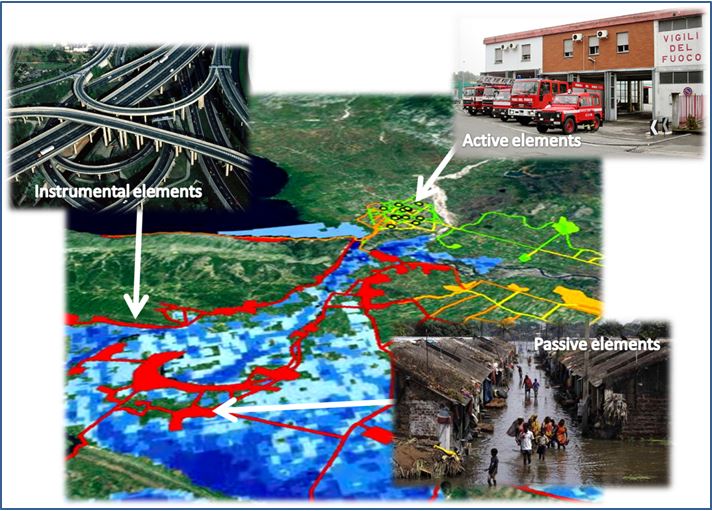
Digital Earth Action Task3 has been developed inside a Bachelor Thesis in Environmental Engineering at University of Genoa in 2011.
Inside this task, a methodology for the systemic vulnerability assessment of infrastructure networks subject to floods have been developed. In this approach the territorial system is modeled through the application of graph theory : roads, villages , buildings are the nodes of the graph while the edges are represented by their topographic connections. Since the arcs are links that do not take into account the topographical functional dependencies between the elements, this approach can also be applied in areas known only from remote observation.
The relevant territorial elements are those that play a significant role in the emergency management:
The information related to the network is organized in a database , which contains tables specific for each type of exposed element, inside which it is possible to collect all the available information.
The response of the network to the external stress is evaluated by applying an algorithm developed in literature by Minciardi et al.[i], modified to receive in input the residual function of each network element, that is function of the considered hydraulic scenario through damage curves. The algorithm provides as output a value of residual efficiency for the active and instrumental element and a value of criticality for the passive elements, analyzing the influence that each active node and instrumental exercises on the other nodes in the network.
[i] R. Minciardi, R. Sacile, A.C. Taramasso, E.Trasforini, S. Traverso., Modeling the vulnerability of complex territorial systems: An application to hydrological risk, Environmental Modeling & Software 21 (2006) 949-960.

The DEAs partecipated to the International FOSS4G Conference in Nottingham 19-21 September. Great fun, new knowledges… The world of Open Source is full of open mind and open heart people! (photo by Marco Minghini)
 Digital Earth Action